

In a nutshell: The most important things at a glance
D-Ribose: How It Benefits Energy Production, Recovery and Health
D-Ribose is a simple sugar that your body needs to make energy and certain molecules. It is naturally found in your body and is also widely used as a dietary supplement. It may speed exercise recovery, help with heart conditions and smooth wrinkles.
While your body produces ribose naturally, metabolic stress, strenuous physical exertion or chronic illness can drain cellular energy reserves faster than your body can rebuild them. Taking D-Ribose as a dietary supplement helps accelerate the restoration of cellular energy (ATP), offering targeted support for post-workout muscle recovery, cardiovascular function and energy-depleting conditions like Chronic Fatigue Syndrome and fibromyalgia.

What is D-Ribose?
D-Ribose (also referred to as ribose in this article) is a type of sugar made with five carbon atoms known as a pentose. Ribose forms the backbone of RNA, the genetic material involved in translating genes into protein. Ribose is also a component of molecules involved in energy metabolism, including ATP, coenzymes such as nicotinamide adenine dinucleotide hydride (NADH), and vitamins such as niacin (vitamin B3) and riboflavin (vitamin B2).
Ribose is naturally produced in the body via the pentose phosphate pathway, but small amounts can also be obtained from the diet as ribose is found in meats, vegetables and soy-containing products. Ribose is also sold as a dietary supplement designed to boost energy levels and support recovery in athletes.
There are two forms of the sugar ribose: L-Ribose and D-Ribose. L-Ribose is man-made (non-natural), and your body makes D-Ribose. Your cells use the simple sugar to make RNA, DNA and adenosine triphosphate (ATP). ATP supplies energy to your cells.
You can also find small amounts of this sugar in ripe fruits and veggies. Many companies add this supplement to energy drinks and claim it boosts your performance. Some beauty products use the sugar for anti-aging.
How does D-Ribose work?
Under normal conditions, the body synthesizes ribose slowly from glucose through a multi-step pathway. This process is rate-limited by enzymes. When tissues experience metabolic stress (such as intense exercise, cardiac ischemia, or chronic fatigue), ATP levels drop rapidly. The slow natural synthesis of ribose becomes a bottleneck in rebuilding ATP. Supplementing directly with D-Ribose bypasses this slow enzymatic step, allowing cells to rapidly replenish adenylate pools (cellular energy reserves) and restore cellular energy production.
What are the main benefits of D-Ribose?
Potential benefits for heart health
Ribose may provide energy for heart cells. Some review papers claim that ribose can treat heart failure in people with coronary artery disease; however, much of the evidence comes from preclinical studies in rodents.That said, some randomized controlled trials (RCTs) have found that supplementation with ribose (in addition to heart failure medications) can improve the symptoms of heart failure, including increased left ventricular ejection fraction and exercise capacity with heart-conditions, both of which are impaired in people with this condition.
Potential benefits for performance and exercise recovery
Some RCTs show that supplementation with D-Ribose can reduce feelings of muscle soreness and markers of muscle damage and oxidative stress following exercise,while increasing the resynthesis of ATP in skeletal muscle. However, the recovery of muscle strength is not improved, therefore, ribose might assist with recovery, but it does not improve exercise performance. Consuming 5g to 15g doses before and after training can help alleviate DOMS (Delayed Onset Muscle Soreness) and support tissue recovery. If you are looking to try it yourself, a clean, vegan-friendly FunVital© D-Ribose Powder supplement allows for flexible daily dosing.
For your skin
As skin ages, cells lose ATP and energy. Some companies promote this sugar in skincare products. Adding it to facial lotion may help restore ATP to your skin.
Cellular fuel: how D-Ribose helps combat fibromyalgia and chronic fatigue
Study overview : An open-label pilot study evaluating the effects of supplemental D-Ribose (5 g three times daily) on 41 patients diagnosed with Fibromyalgia (FMS) and/or Chronic Fatigue Syndrome (CFS).
Results : Approximately 66% of patients experienced significant clinical improvements. On average, patients showed a 45% increase in energy and a 30% improvement in overall well-being, alongside notable reductions in pain, sleep disturbances, and brain fog. D-Ribose was well-tolerated with no adverse effects.
Conclusion : D-Ribose supplementation significantly reduced clinical symptoms and improved cellular energy-related metrics in patients with fibromyalgia and chronic fatigue syndrome, suggesting it is a potentially useful metabolic adjunct therapy (though larger, rigorous studies are still needed).
Effective dosages
Formulation
D-Ribose is taken in tablets/capsules or loose powder dissolved in water.
Range of dosages studied
3 to 60 grams per day, often divided into 3 to 4 doses throughout the day.
Heart failure
The effective dosage for adults for improving symptoms of heart failure, e.g., increased left ventricular ejection fraction and exercise-capacity-with-heart-conditions, is 15 to 60 grams by mouth per day for 1 to 12 weeks. Typically, the daily dose is divided into 3 to 4 × 5 to 15-gram doses spread evenly throughout the day.
Special considerations : Some evidence shows that the rapid absorption of orally ingested ribose is blunted when co-ingested with a high-fat or high-carbohydrate meal.
Exercise recovery
The effective dosage for adults for reducing feelings of muscle soreness, reducing markers of muscle damage and oxidative stress, and enhancing the resynthesis of ATP in skeletal muscle following exercise is either 15 grams taken orally immediately before exercise, 7 grams taken orally immediately before and after exercise, 10 to 16 grams per day taken orally for 2 to 6 days, or 200 milligrams per kilogram of body weight taken orally 3 times a day for 3 days (equivalent to 42 grams/day in a person weighing 70 kg). However, not all studies confirm such effects, and more research is needed.
Dietary sources
D-Ribose is found in only very small amounts in food, including:
- Meat and poultry
- Organ meats (e.g., liver, heart)
- Dairy products
- Brewer's yeast
- Ripe fruit and vegetables.
But food sources are not enough to raise ribose levels. Simply because it's in material form such as ATP, DNA, and RNA. To reach the amounts used in studies, you'll need to take a supplement.
Side effects
The most common side effect of ribose is a drop in blood sugar levels. This side effect may vary depending on how high dose you are taking or the specific product you are using. Tell your health care provider if you have any side effects that bother you.
While less common, the most serious side effects of ribose are described below.
- Severe allergic reactions. Ribose may cause allergic reactions, which can be serious. Stop taking ribose and get help right away if you have any of the following symptoms of a serious allergic reaction.
- Breathing problems or wheezing
- Racing heart
- Fever or general ill feeling
- Swollen lymph nodes
- Swelling of the face, lips, mouth, tongue or throat
- Trouble swallowing or throat tightness
- Itching or skin rash
- Bumps on the skin called hives that can be red, pink, white or brown depending on your skin tone
- Nausea or vomiting
- Dizziness, feeling lightheaded or fainting
- Stomach cramps
- Joint pain
- Low blood sugar. D-Ribose can stimulate insulin secretion or temporarily lower blood glucose levels. It is strongly recommended that diabetics or those taking insulin/glucose-lowering medications consult a physician before using ribose.
Key takeaways
D-Ribose is a vital simple sugar that fuels cellular ATP production. While it does not boost peak athletic performance, clinical evidence highlights its ability to reduce post-exercise muscle soreness and ease symptoms in conditions like heart failure, chronic fatigue, and fibromyalgia. D-Ribose is generally safe, but because it can lower blood sugar levels, consult a doctor before starting supplementation, particularly if you have diabetes.
Warning : Keep ribose out of the reach of children.
A varied and balanced diet and a healthy lifestyle are recommended. Store in a cool, dry place.
This article provides general information only and should not be used for self-diagnosis or self-treatment. Always inform yourself about the use of food supplements by reading the package leaflet or asking your doctor or pharmacist.
If you are using Ribose powder, use an appropriate measuring device to measure the powder. Read the label carefully
and measure the amount stated on the label.
First published: 14.10.2026
Updated: 14.10.2026
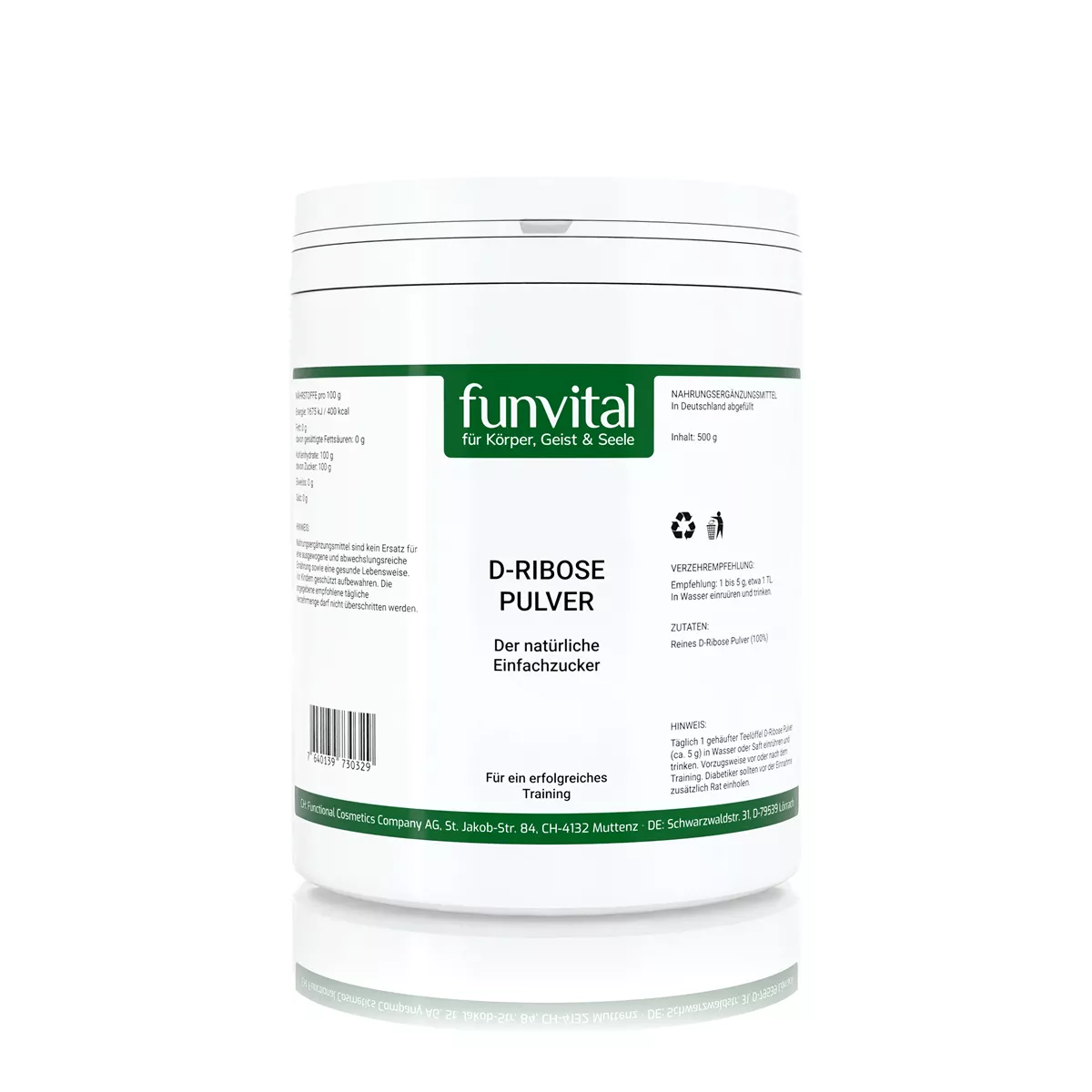
Content: 0.5 Kilogram (€59.60 / 1 Kilogram)

Content: 0.06 Kilogram (€1,141.67 / 1 Kilogram)
Content: 0.5 Kilogram (€25.80 / 1 Kilogram)