

In a nutshell: The most important things at a glance
L-Arginine: Benefits, Side Effects and How to Choose the Purest Form
Whether you are looking to boost your physical performance, support your cardiovascular health or improve your daily energy, you’ve likely ran across L-arginine. This crucial amino acid is the driving force behind your body’s nitric oxide production, helping to open up blood vessels and keep your cells working efficiently.
But before you grab the first bottle off the shelf, understanding how this supplement is made, and how to avoid common digestive side effects, can make all the difference for both your stomach and your wallet. Here is everything you need to know about L-arginine's benefits, food sources, drug interactions and the science behind choosing the purest form.

Overview
L-arginine is an amino acid that is naturally found in foods. It is also available over the counter as a supplement. L-arginine is sometimes used to reduce blood pressure, relieve chest pain and help with erectile dysfunction. Although L-arginine may provide some benefit for these uses, it may not offer enough benefit to help manage these conditions.
Common side effects include diarrhea and an upset stomach, especially with high doses. Before taking L-arginine, make sure to tell your health care provider about any health conditions you have or medicines you are taking.
L-arginine is semi-essential (conditional), which means that your body can produce the amino acid, but you also need to include some sources of the amino acid in your diet.
What are amino acids?
Amino acids are molecules within your body that produce proteins when they combine with other molecules. An amino acid chain forms a protein. Proteins are an essential part of what makes humans function, because every cell in the human body contains protein. Your body also uses amino acids to produce energy.
Do I need protein in my diet?
Protein in your diet helps your body function efficiently. Each cell in your body contains protein. Proteins help your body:
- Build and repair new cells essential for growth.
- Repair damaged tissues.
- Help cells complete their assigned function.
- Break down and digest food.
What is L-arginine commonly used for?
L-arginine can help support or manage several conditions including:
- Chest pain or pressure (angina).
- Erectile dysfunction.
- Heart failure.
- High blood pressure (hypertension).
- Migraines.
What foods contain L-arginine?
Foods that are high in protein naturally contain L-arginine including:
- Meat (red meat, chicken, turkey).
- Fish (salmon, haddock).
- Nuts and seeds (almonds, cashews, pumpkin seeds).
- Legumes (soybeans, chickpeas).
- Whole grains (brown rice, oats).
- Dairy products (milk, yogurt, cheese).
How long does it take for L-arginine to work?
Depending on your reason for taking l-arginine and which type of amino acid you need, it takes a minimum of 24-hours for the L-arginine to absorb into your body. In some cases, to see the full effects of regular L-arginine treatment, it could take up to three months.
Side effects
Side effects are possible with l-arginine treatment and could include:
- Bloating.
- Diarrhea.
- Dizziness.
- Nausea or vomiting.
Life-threatening side effects include:
- Allergic reaction (hives, itching or rash).
- Difficulty breathing or a tight feeling in your chest.
- Heart failure.
If you experience any side effects, reach out to your healthcare provider or visit your nearest emergency room immediately.
Are there any serious interactions with L-arginine?
L-Arginine interacts with other medicines, so don’t take it without first consulting your health care provider about medicines you currently take. L-Arginine interacts as below:
Medicine & Type
- ACE inhibitors: Benazepril, enalapril, lisinopril.
- Alpha-blockers: Doxazosin, prazosin.
- Angiotensin receptor blockers: Candesartan, irbesartan, losartan, valsartan.
- Beta-blockers: Atenolol, carvedilol, labetalol, metoprolol.
- Calcium channel blockers: Amlodipine, diltiazem, nifedipine, verapamil.
- Nitrates: Isosorbide, nitroglycerin
- Propranolol: Hemangeol.
- Vitamins or natural remedies. Fish oil.
L-arginine can cause interactions if you have certain health conditions. You shouldn’t take L-arginine if you:
- Recently had a heart attack.
- Have a guanidinoacetate methyltransferase deficiency.
- Are a child under 16 years of age, are pregnant or breastfeeding or are an adult older than 65 years of age without approval from your provider.
The interactions between L-arginine and medicines are not fully understood. As with most dietary supplements, the research on drug interactions with L-arginine is incomplete.
Wrap Up: Why Purity & pH Matter
Not every bottle of L-arginine on the shelf will deliver the same results. The quality, purity and manufacturing standards vary significantly.
If you decide to add an L-arginine supplement to your routine, understanding how it is made can help you have more value for your money. In this section we explain why and how.
There are two types of L-arginine: L-arginine HCl and L-arginine Base. L-arginine HCl is less odorous, less flavourful and more water-soluble than L-arginine Base, but it's only 75-83% pure L-arginine. L-arginine Base, on the other hand, dissolves more slowly in water but is 98.5-100% pure L-arginine.
Fermentation vs. Synthetic Extraction
In addition to the difference between L-arginine Base and L-arginine HCl, there are two different manufacturing methods: fermentation and extraction.
High-quality L-arginine is typically produced through natural plant fermentation (often using plant-based carbohydrates). Lower-quality, cheaper alternatives are sometimes chemically extracted from animal byproducts like feathers or hair. Fermented L-arginine Base yields a purer, more bioavailable product that is also suitable for vegans.
The pH Factor
The pH value measures a substance's acidity. The scale ranges from 1 to 14, with 1 being the strongest acid, 7 being neutral (like water), and anything above 7 being basic. These substances are called bases or alkalis. When metabolized, plant-based foods are considered basic, while animal products are acid-forming. Basic foods are generally considered healthier.
In its raw, "free form" state, L-arginine is highly alkaline (a high pH level). If you take a highly alkaline powder or capsule, it can neutralize your stomach acid, leading to the nausea, bloating, and diarrhea mentioned in the side effects.
The ATP & Energy Connection
The science behind L-arginine's effectiveness comes down to cellular energy. L-arginine is a direct precursor to nitric oxide (NO), a gas that dilates your blood vessels to improve blood flow. It is also required by the body to synthesize creatine. Together, improved blood flow and creatine synthesis directly support the production of ATP (adenosine triphosphate) — the primary energy currency of your cells. This is why L-arginine is so highly valued not just for cardiovascular health, but for cellular energy and physical performance.
When evaluating a supplement, it helps to understand why the "Base" form is so unique. L-arginine Base has a significantly higher purity level than L-arginine HCl, meaning you don't have to take massive doses to achieve the same effect. Furthermore, L-arginine Base is basic (alkaline), while arginine hydrochloride is highly acidic. Because this specific powder is made through a purely plant-based fermentation process, it delivers a clean, superior quality that synthetic or animal-derived HCl alternatives simply cannot match.
--------------------
Warning : Not suitable for children, pregnant women, nursing mothers or individuals who have suffered a heart
attack. Individuals taking blood pressure medication, following a low-protein diet, or suffering from
kidney or liver disease should consult their doctor before using this product.
This article provides general information only and should not be used for self-diagnosis or
self-treatment. It cannot replace a visit to a doctor. Always inform yourself about the use of food
supplements by reading the package leaflet or asking your doctor or pharmacist.
First published: 16.07.2026
Updated: 16.07.2026
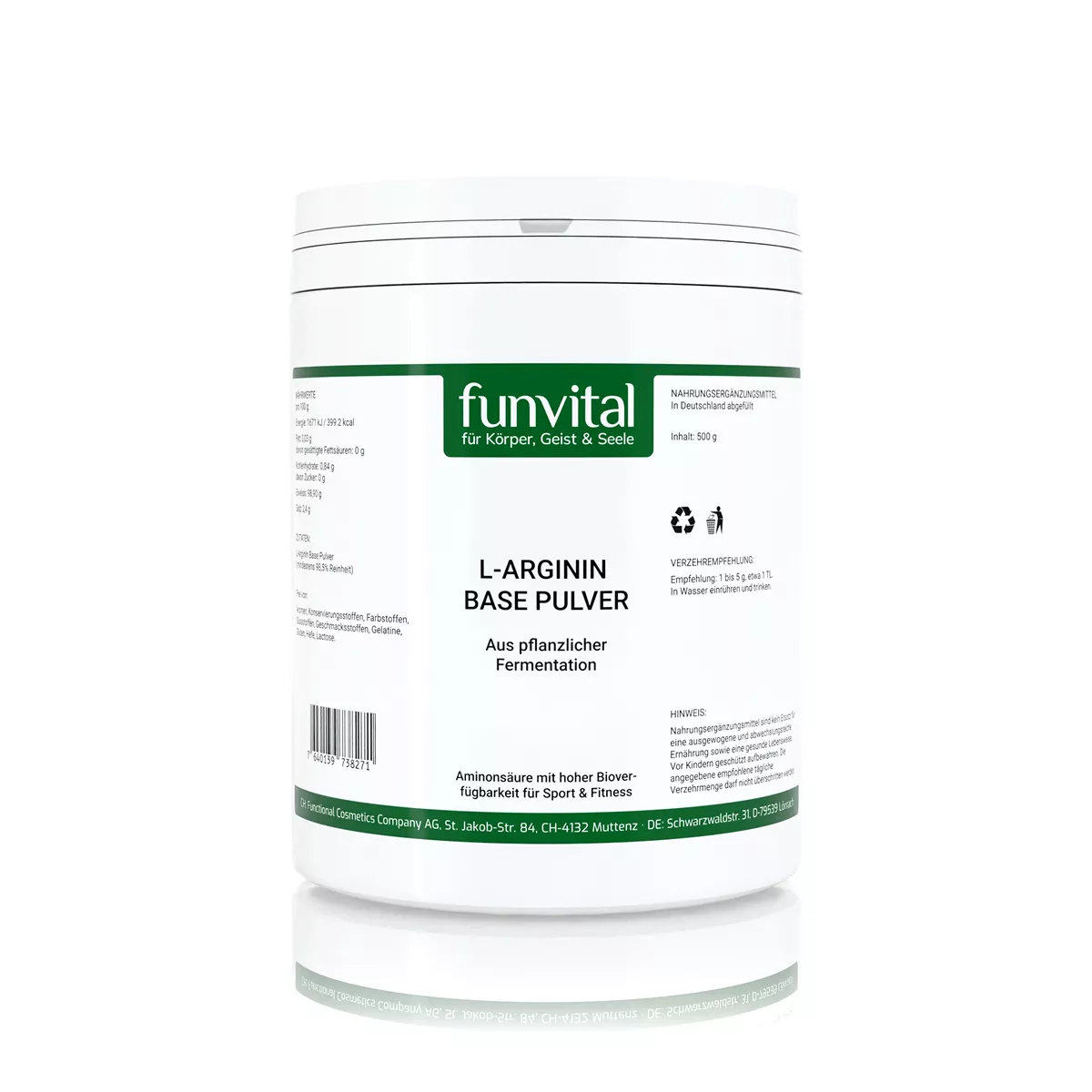
Content: 0.5 Kilogram (€46.40 / 1 Kilogram)
Content: 0.5 Kilogram (€39.80 / 1 Kilogram)
Content: 0.5 Kilogram (€25.80 / 1 Kilogram)